AI in Automotive Diagnostics
Why AI Has Earned a Place in My Diagnostic Toolbox
By Ali Ahmed,
Automotive Electrician & IMI Level 4 EV Technician — The Car Electrician Ltd
Can we talk about AI?
I know this may earn me some grief from my fellow technicians—but please, bear with me.
For years, a significant part of my diagnostic work happened after I had left the vehicle.
I would spend hours at my laptop, surrounded by wiring diagrams, service information and automotive technical data, with a pen and paper beside me. I would break down complex manufacturer diagrams, redraw circuits in a form that made sense and carefully build a logical diagnostic plan.
Much of this was done in my own time. Partly because I cared about getting the answer right, and partly because I did not want to pass hours of additional research time on to my customers. Inevitably, that time came from somewhere—usually the time I could have spent with my family.
Then a talented younger auto electrician suggested that I try AI.
My first reaction was to laugh and mock the idea. Once I had got that out of my system, I decided to give it a fair chance.
What a revelation that turned out to be.
Where AI genuinely helps
Automotive electrical diagnosis is not about guessing or replacing parts until a fault disappears.
A large part of the job involves collecting evidence, interpreting data, identifying relationships and deciding which test should come next.
That is where AI can be extremely useful.
It can help organise large amounts of technical information, compare fault codes and freeze-frame records, identify patterns and highlight inconsistencies that deserve further investigation. It can also help me structure a diagnostic plan, question my own reasoning and avoid becoming fixed on the first possible explanation.
It does not provide a final answer. It helps me decide where the evidence suggests I should look next.
A small detail with a big consequence
A recent investigation demonstrated exactly why AI has earned a place in my diagnostic process.
The vehicle would cut out unexpectedly while being driven. It had already undergone an engine ECU replacement, costing the customer more than £1,000, yet the original fault remained and the vehicle was still unrepaired.
While reviewing the stored freeze-frame records, AI-assisted analysis highlighted a subtle timing relationship across several faults. Within seconds of the faults being recorded, the data showed evidence consistent with a temporary loss of power to the engine ECU.
This did not establish the root cause or replace physical testing. What it provided was a focused, evidence-led diagnostic direction that could be independently verified through traditional circuit testing.
It was the kind of small relationship that could easily be missed when comparing numerous records manually. Yet in automotive diagnosis, a detail like this can mean the difference between testing the correct power-supply circuit and replacing another expensive component unnecessarily.
That is where AI provides genuine value: not by deciding the answer, but by helping me see where the evidence is pointing.
What AI cannot replace
This distinction is essential:
AI does not diagnose vehicles for me.
It cannot operate a multimeter, carry out a loaded voltage-drop test, inspect the physical condition of a connector or assess a circuit while it is under real operating conditions.
It can misunderstand information, make incorrect assumptions and sometimes be completely wrong.
Every suggestion must therefore be checked against reliable technical information, direct measurements, known-good values and practical experience. I still perform every physical test and remain responsible for every diagnostic conclusion.
There is—and never will be—a substitute for knowledge, training and hands-on judgement.
What the customer gains
Most customers do not want a lecture about data analysis. They want their vehicle fixed correctly, without guesswork or unnecessary parts being fitted.
That is entirely understandable—and it is exactly why this matters.
Used responsibly, AI can help me organise the evidence more efficiently, focus the next physical test and challenge my own assumptions before reaching a conclusion.
It also helps me turn my findings into a clear, professionally structured diagnostic report. As I work, I can record my observations, measurements and test results. Afterwards, AI can help organise those notes into a first structured draft, which I then review, correct and finalise.
The customer receives more than an invoice or a verbal explanation. They receive a written record of what was tested, what was found and how the conclusion was reached.
A tool—not a shortcut
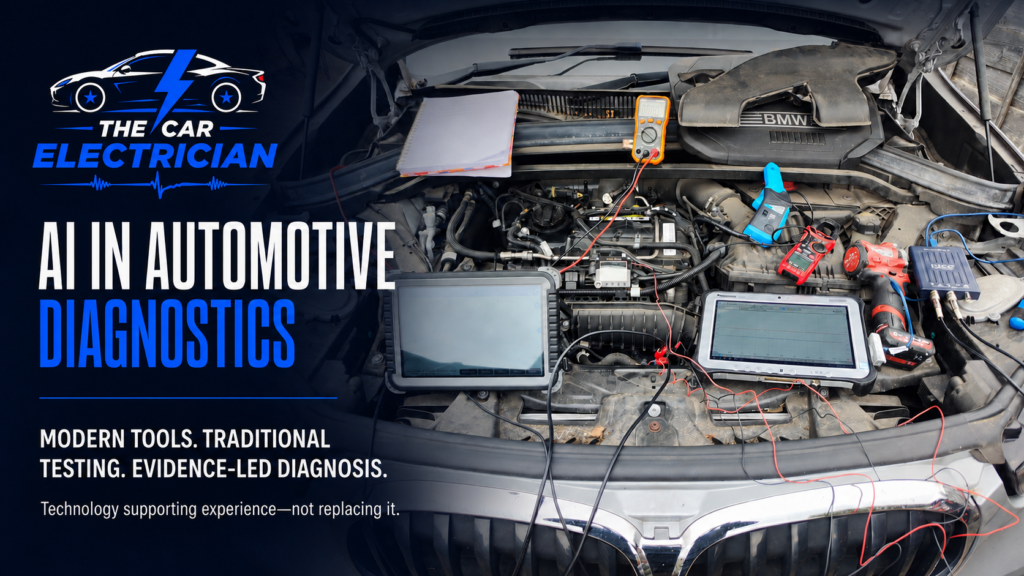
I do not feel ashamed of using a PicoScope, scan tool, current clamp or technical database. None of those tools diagnoses a vehicle by itself. Their value depends on the knowledge and judgement of the person using them.
AI should be viewed in much the same way: a powerful but fallible tool that requires knowledgeable interpretation and independent verification.
This is why I continue to invest in training and current technical knowledge, remain on the IMI TechSafe register and keep pace with an industry that never stops evolving.
The more advanced our tools become, the more important the fundamentals become.
For technicians and apprentices, the lesson is not to hand our thinking over to AI. It is to use it to organise information, question our reasoning and identify relationships—and then prove or disprove those ideas through proper testing.
For the customer, the benefit is much simpler: a more focused, transparent and evidence-led diagnostic process.
AI has not replaced my knowledge or experience. It has earned its place in my diagnostic toolbox.